
Summary: If you know or suspect you have been sued for a debt in Washington, know that you have options to fight back against the debt collector. Staying up to date on your case status will increase your chances of winning. Washington Courts make it easy to find your case in person at the courthouse or online. When sued for a debt, use SoloSuit to respond with a written Answer and win in court.
Finding your lawsuit in Washington is easy, thanks to the provisions made by the government to allow its citizens to access their records either online or by visiting the courthouse where the creditors filed the case. Viewing your records and staying up-to-date on your case can help you prepare the strongest responses possible and receive a favorable judgment.
Unfortunately, most consumers either do not respond to the lawsuit or fail to appear in court—some out of ignorance and others out of fear and feeling intimidated. As a result, debt collection agencies receive judgments in their favor and become legally empowered to continue making your life miserable through means such as wage garnishment and putting liens on your property. But that doesn’t have to be you. This article will help you learn how to navigate Washington’s judicial system and how you can access your court records.
Let’s get right to it.
Sued for debt in Washington? Use SoloSettle to resolve your debts.
Washington court structure
When you understand how Washington’s judicial system is structured, it will be easier to find your case information because you’ll know what type of court has jurisdiction over the lawsuit. Since debt collection lawsuits are considered civil cases, we will focus on the Washington civil court structure in this section.
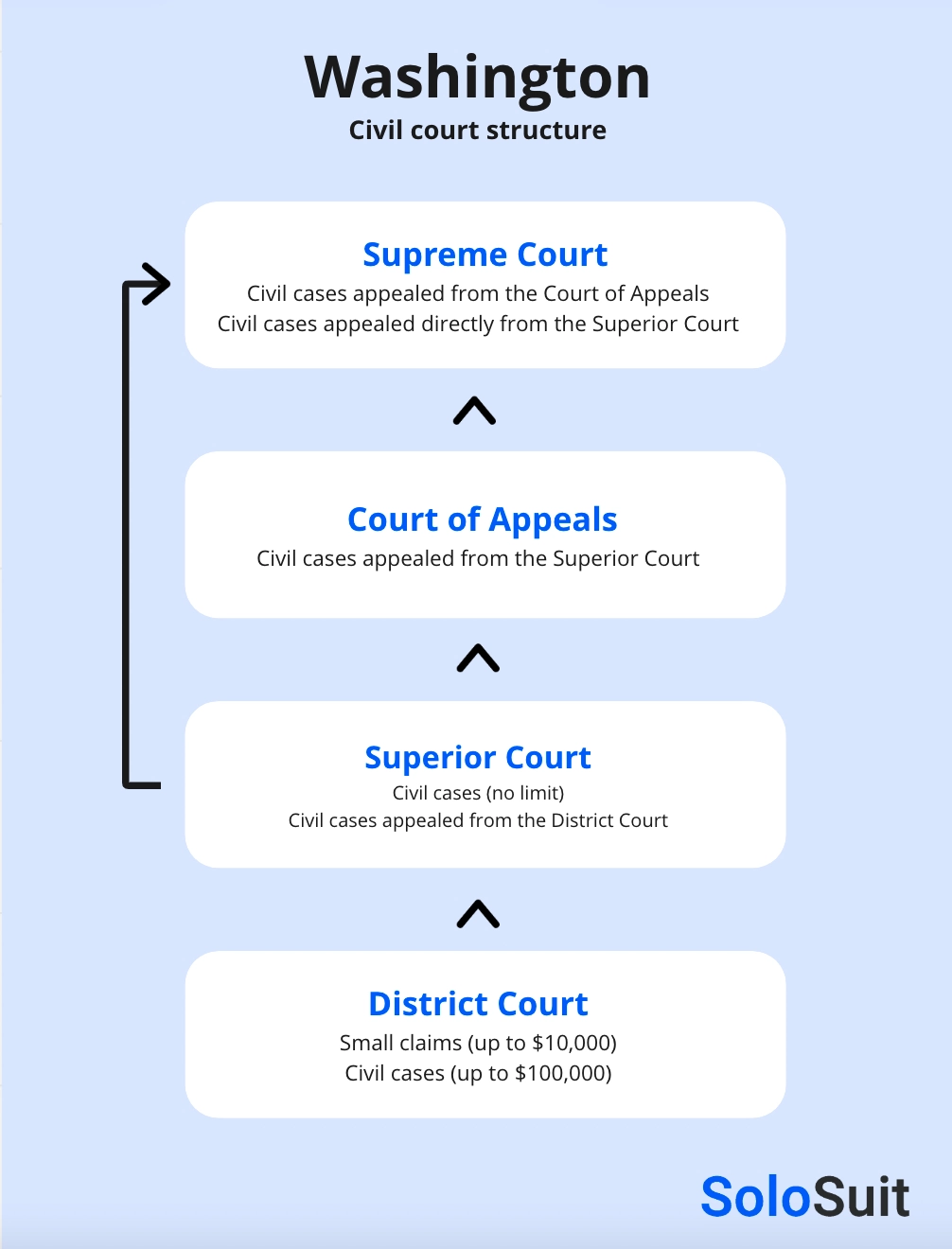
Washington's well-structured court system makes its services reliable. The state has four primary court levels; the Supreme Court, the Court of Appeals, the Superior Court, and the District Court. Let’s briefly discuss each and what types of cases they handle.
- Supreme Court: This is the highest court in Washington and hears appeals from the lower courts. The judges have original and appellate jurisdiction over most matters presented to them. They also play an administrative role in the judicial system, ensuring everything works well by addressing complaints or disciplinary issues.
- Court of Appeals: This is the next ranking court after the Supreme Court. The judges hear appeals from the other lower courts and either modify, reverse, or affirm the decision made by the previous judge. The appellate jurisdiction for this court is non-discretionary, meaning it doesn't reserve the right to say no to any appeal request.
- Superior Court: This is the state’s trial court of general jurisdiction, meaning it handles civil cases with no monetary limit and appeals from the district courts. These courts are divided into districts, each representing a single county except for sparsely populated ones that share a district.
- District Court: This court has exclusive jurisdiction over civil cases involving claims of up to $100,000 and small claims not exceeding $5,000. Parties can appeal to the Superior Court if dissatisfied with the decisions.
The graphic below further outlines the Washington civil court structure:
Your debt collection case will most likely be heard in the District Court under the small claims division, depending on how much money is involved. The small claims division does not allow lawyers to argue cases but permits individuals to represent themselves.
You might feel overwhelmed at the thought of representing yourself in court, but SoloSuit makes responding to a debt collection lawsuit easy. Check out this video to learn how to draft and file an Answer to your debt lawsuit in minutes:
How to find your case number in Washington
In Washington, it is a requirement for all matters presented to the court clerk to receive a case number. This rule helps to organize court files and enables the clerk to access the records easily for court proceedings or when you make a request. The number can be made up of characters, digits, or letters.
For example, in the Superior Court case number (22 2 00097 8), the first two digits show the year the creditors filed the case, the third digit is the case type code, and the next digits are the sequential number of the case for the current year. The last digit is a check digit for the computer to confirm the accuracy of the case number.
Your case number is usually written in the lawsuit. If you misplace the letter, you can find your case number by requesting the court custodian to search for it after submitting a written request at the courthouse. Alternatively, you can go online to the Washington Court Case Search Portal and search using the party search option.
Example: Nancy had a debt of $3,432 with Olympic Collections. They had agreed that she would pay a bulk amount, and they'd forgive the rest of the debt. Before she could send the money, someone accessed her bank account and wiped it clean. Nancy tried to explain this to OC, but they did not believe her story. Instead, they sued her. Nancy used SoloSuit to respond to the lawsuit with a strong defense, and she called the courthouse every few weeks to check the status of her case. Staying up-to-date with her case helped Nancy feel more prepared and less stressed about the lawsuit.
How to access your court records in Washington
A debt collector typically hopes you will feel intimidated about the lawsuit and not show up in court to defend yourself. But with access to your court records, you can prepare well and reduce the anxiety of standing in front of a judge. Washington ensures it is not a stressful process to gain access by visiting the courthouse or online.
Access your Washington court records in person
In-person access conveniently helps you access detailed court records; you’ll probably get copies of the case documents filed by both you (like your Answer) and the opposing party. The first step to accessing your records is to find the court location where your case is filed. The state provides a detailed Washington court directory. Visit the page, look for your county, and click on it. You'll be redirected to a different page with the courthouse contact information, including the physical address.
Once at the courthouse, you should be able to ask the court clerk for assistance. In some court, you may be required to fill out a written request. Ensure the information is accurate and names are spelled correctly to enable the clerk to locate the file quickly. Some courthouses even have public self-service portals for citizens to search for the records by themselves.
Access your Washington court records online
Washington Courts have a special online portal where you can search your case and check on its status. You can also find important information like your case number on this Washington Court Case Search Portal. Just use one of the following search criteria:
- Case search
- Person search
- Attorney search
- Find my court date
Depending on your chosen option, the results will bring your case only or a short list of other cases with similar details. It will be easy to find your case from the list or include more filters to narrow down the search.
SoloSuit can help
Our company’s commitment is to help consumers handle their debt situation by offering documents they can use to respond to creditors at various stages of the collection process. These documents include a Debt Validation Letter, an Answer, and a Motion to Compel Arbitration. You can make an offer to settle with SoloSettle.
Decide what to do next
This calculator is for educational purposes only.
What is SoloSuit?
SoloSuit makes it easy to fight debt collectors.
You can use SoloSuit to respond to a debt lawsuit, to send letters to collectors, and even to settle a debt.
SoloSuit's Answer service is a step-by-step web-app that asks you all the necessary questions to complete your Answer. Upon completion, we'll have an attorney review your document and we'll file it for you.

>>Read the NPR story on SoloSuit. (We can help you in all 50 states.)